Lecture 3: Timbre
In this session we’ll be experimenting some more with our Software. Practically, we’ll be looking at procedural synthesis because the theoretical frame for the session is the notion of timbre.
What is Timbre?
We’re going to situate our discussion in a few highlights from a paper by Denis Smalley, ‘Defining Timbre, Refining Timbre’ (1994, Contemporary Music Review 10(2), 35-48) . We won’t be looking at the whole argument, but I do recommend reading it. Get the pdf at:
www.tandfonline.com/doi/abs/10.1080/07494469400640281 (PDF, EASE login required)
Smalley notes that timbre turns out to be quite a slippery notion:
It is one of those subjects where the more you read and the more you have hands-on compositional experience the more you know, but in the process you become less able to grasp its essence. (35)
Technical definitions, such as the suggestion that timbre describes
that attribute of auditory sensation in terms of which a listener can judge that two sounds similarly presented and having the same loudness and pitch are dissimilar. (ANSI definition, quoted in Smalley, 36)
leave a fair amount to be desired. What if sounds don’t have pitch, for example?
He also warns against too readily reducing timbre to information we are able to determine about spectrum, i.e they’re not the same thing!
we have also become concerned to differentiate what is acoustically present in sounds from what is psychoacoustically pertinent. The maps presented by such aids as spectral analysis or sonograms are one thing; finding a safe perceptual way through these territories is another. The multidimensional complex is not without problems. It can reveal to us the “what” of timbre, and explain the “how,” but that does not mean we can aurally separate out the dimensions involved nor focus our ears on their details, even though we are so sensitive to their minor behavioural changes. (36)
In the end, then, we seem to be left with metaphorical terms that are themselves slippery:
Terms like bright/dull, compact/spread, hollow, dense, may be vague, and vague they are destined to remain since they are qualities, but they have the advantage of an immediate, comprehensible identity and are therefore not to be scoffed at. They are verbal signs that essential qualities have been recognised. (36)
Smalley offers a useful starting definition, which he hones as the paper goes on:
Timbre is a general, sonic physiognomy through which we identify sounds as emanating from a source, whether that source be actual, inferred or imagined. (36)
and continues to make an incredibly important point, for the purposes of this course:
Timbre is concerned with the temporal unfolding and shaping of sound spectra, in other words with spectromorphology. (37)
These ideas of source and temporality correlate with themes we are emphasising: Structure, Gesture, Movement, Context.
It helps us then to move into an examination of timbre via sounds we already know. We’re familiar with the sound of wind, traffic noise, waves lapping on the shore. Andy Farnell offers us some very powerful and useful routes towards understanding Timbre via a technique known as Procedural Audio.
Much of his method is very well explained in his seminal book Designing Sound (2010):
Farnell, Andy. 2010. Designing Sound. Mit Press..
You can access many of his examples by searching the ASPress, or visiting some of the notes here:
Note, the above examples are in PD and we’ll need some other objects in order to continue in MaxMSP.
Lecture Materials
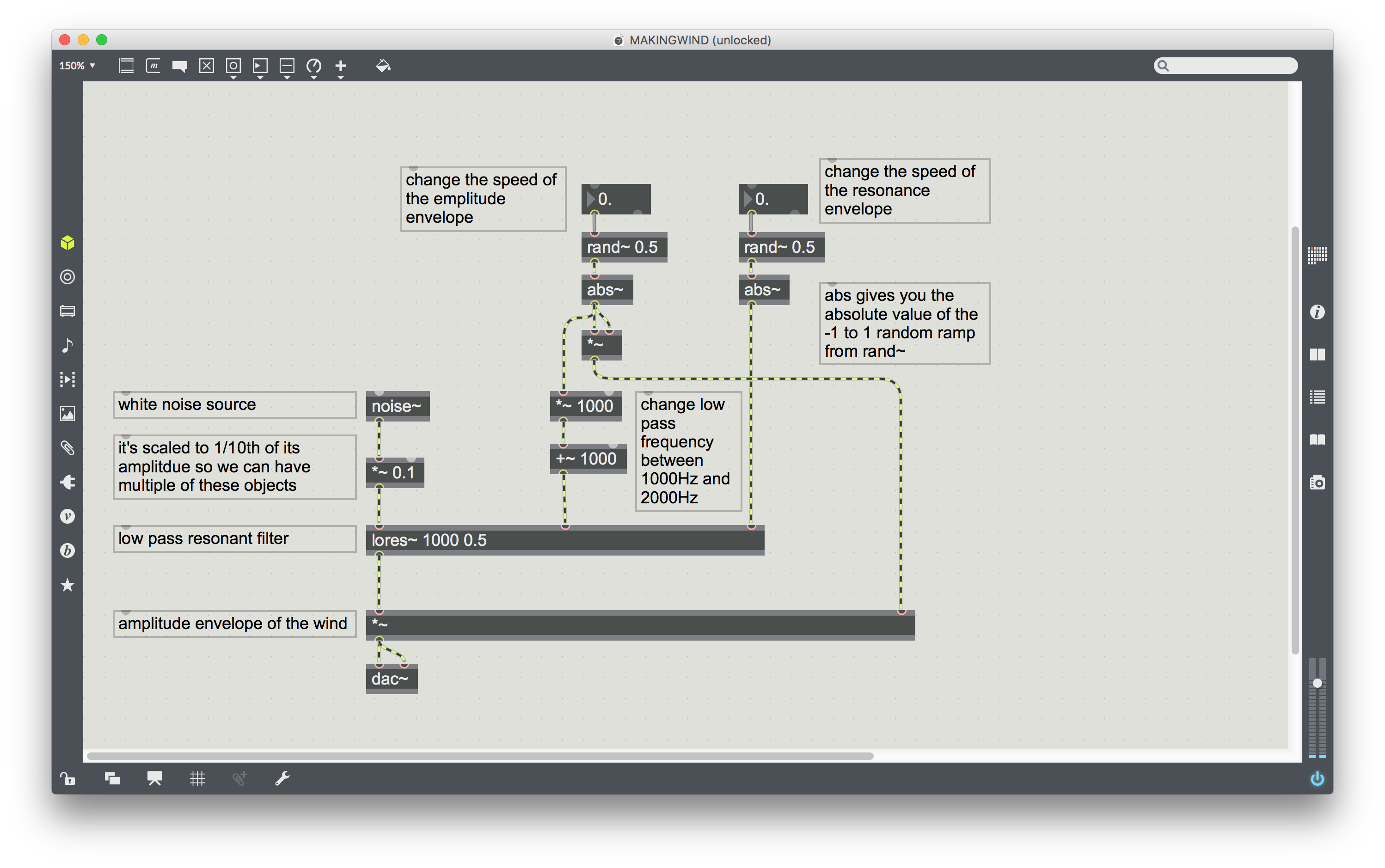
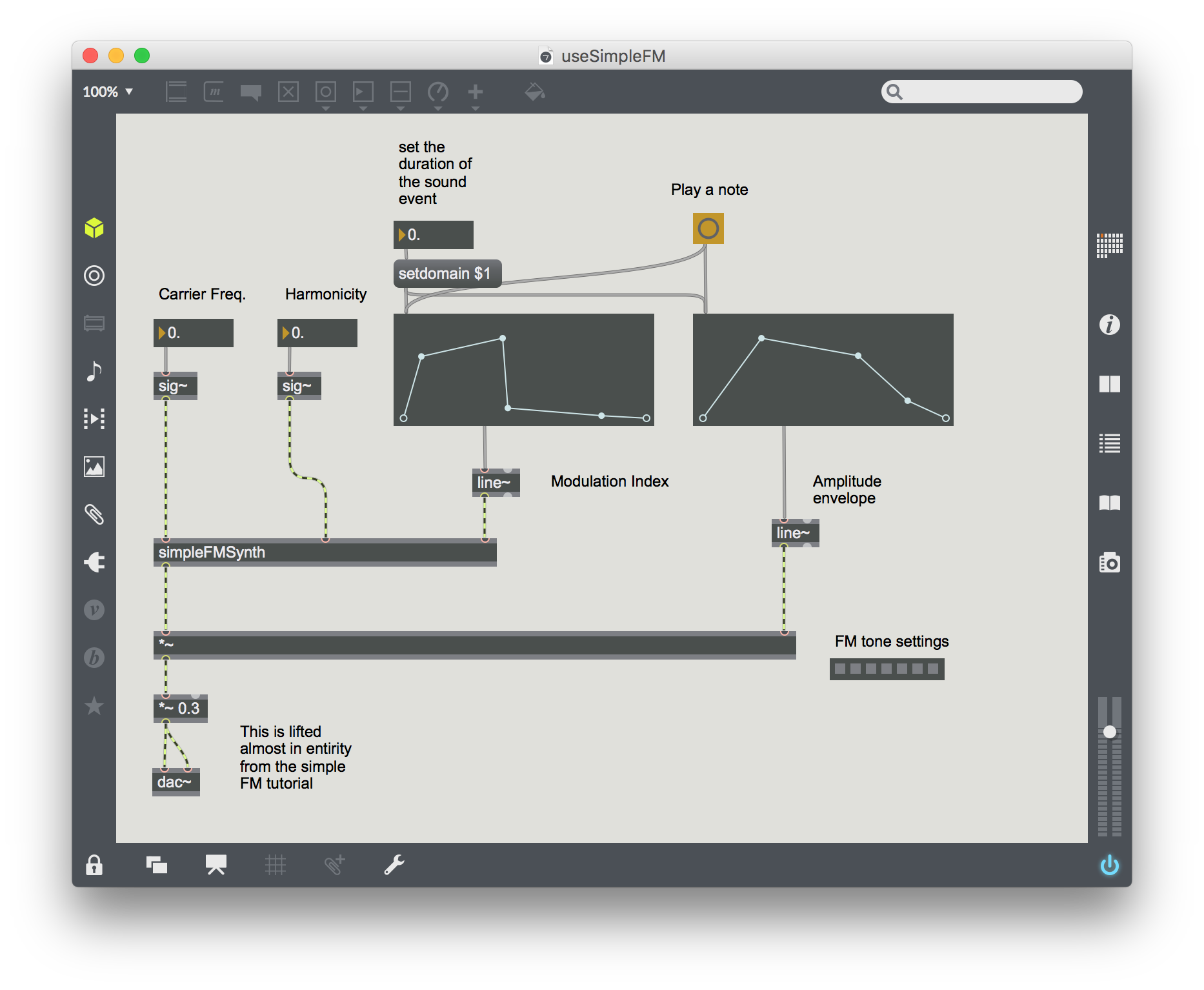
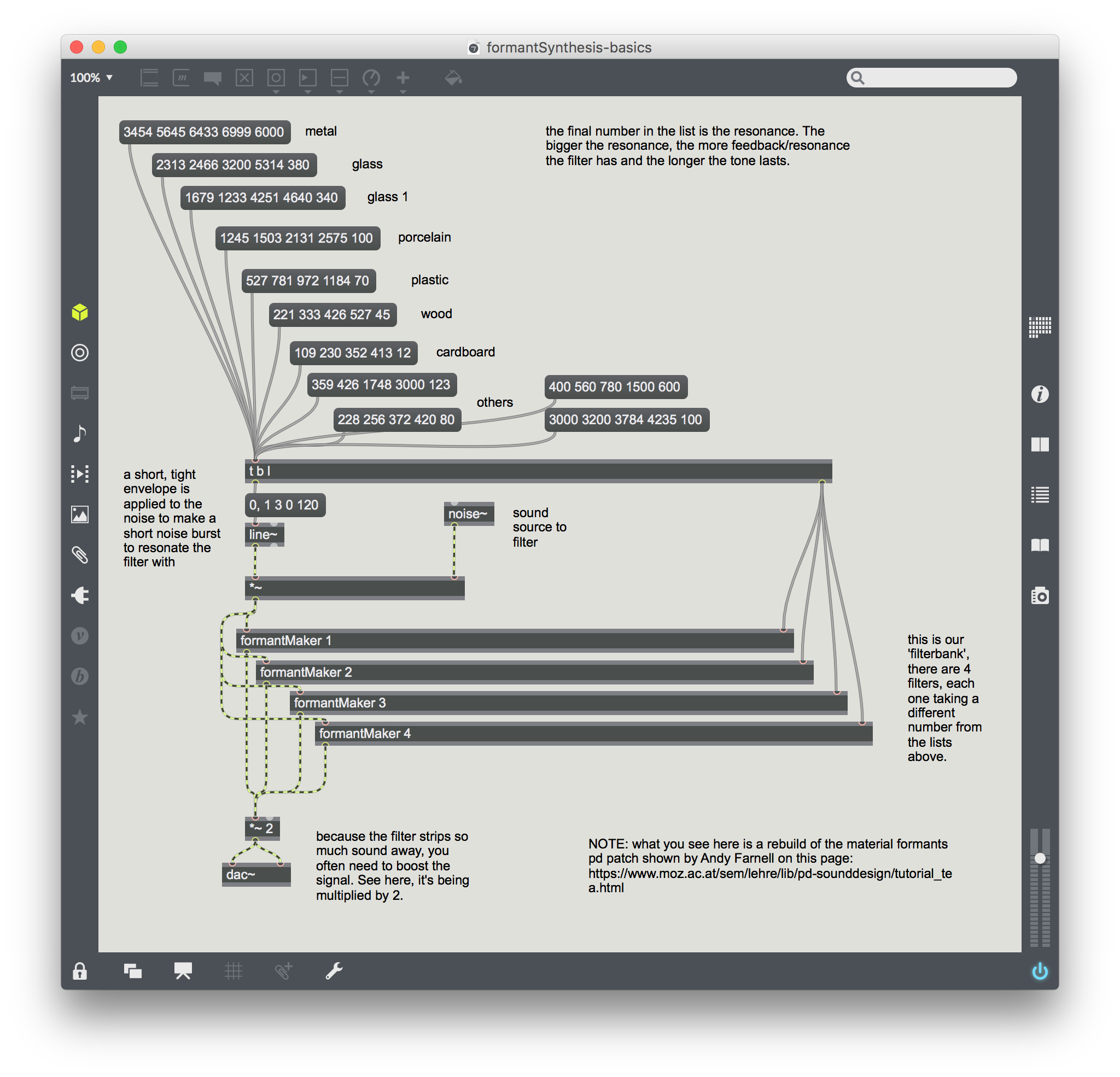
In today’s session we looked at FM synthesis, and then briefly at formant synthesis. Before we did that though, we explored making wind/wave sounds using rand~ to control amplitude and filter parameters. It was pretty effective. The following examples all give you some homework to do in order to help you learn and expand on your knowledge.
Making Wind
The homework here is to think about how you would make this into a reusable abstraction so that you could have multiple layers of wind all coursing around, think about panning too with the pan2s~ abstraction.
FM synthesis
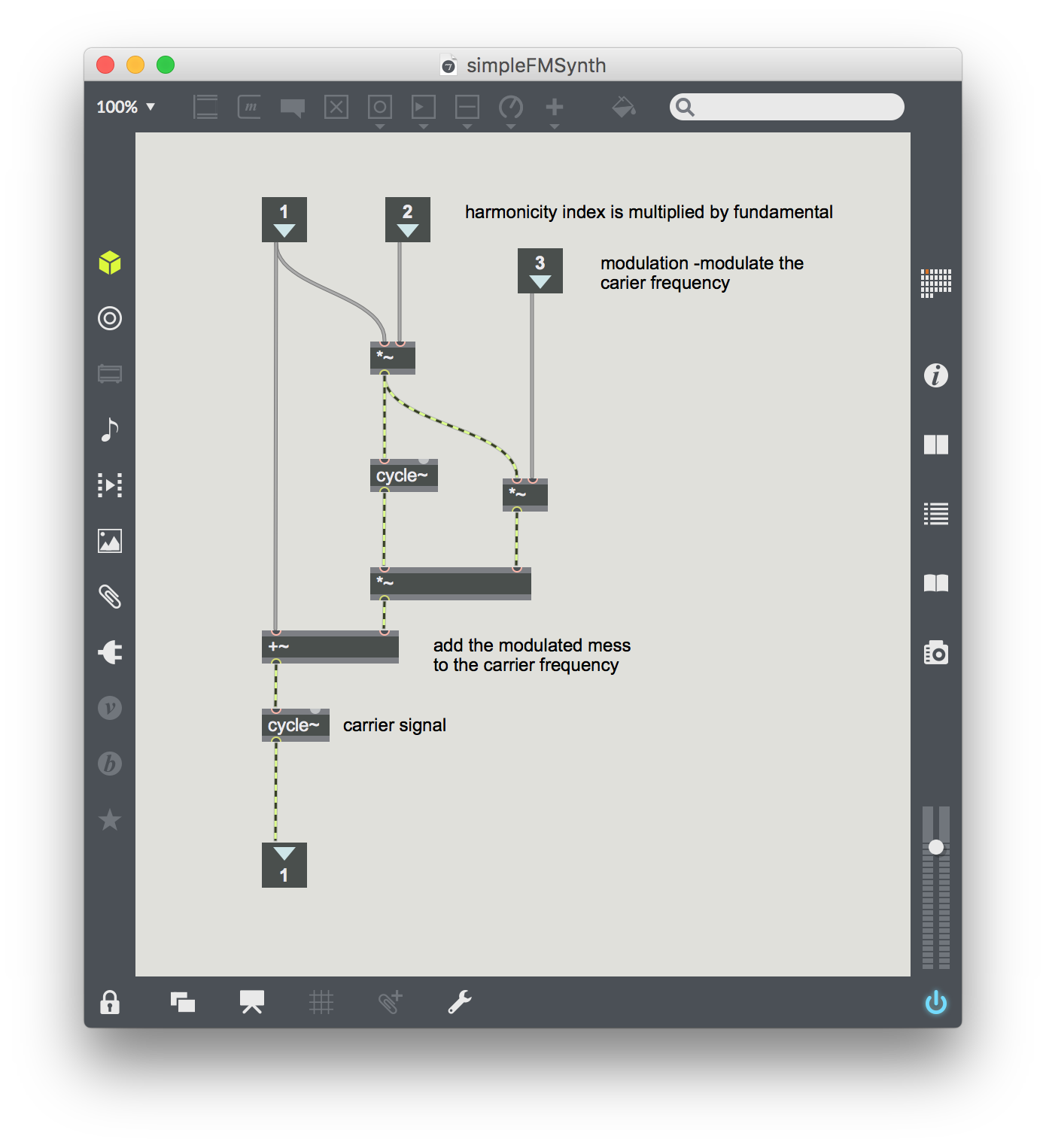
With this basic FM synthesis patch, try and label it up so that you can explain to yourself what each part of the synthesis engine is doing. When you’ve explained it to yourself, try and build your own FM engine.
Some of you may find this page to be a helpful way to explain what’s going on cymatics.fm/blogs/production/fm-synthesis
Basic Formant / Materials Synthesis
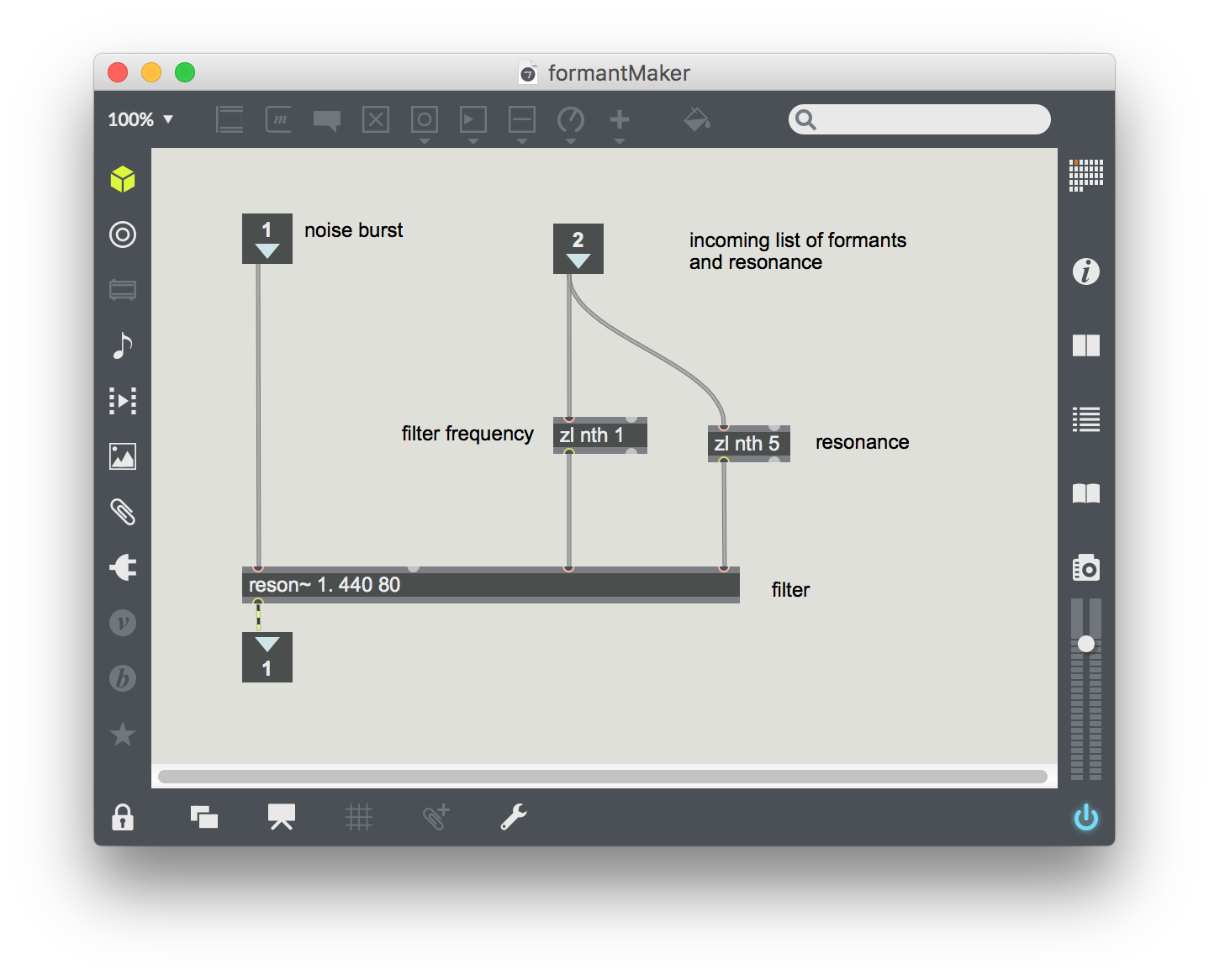
You could explore SPEAR to get the information about the relationships between partials:
In the above example, think about the amplitude relationships between the partials, they’re currently all at the same volume. Could the partials fade away at different times? Could you create more complex lists of data with frequency, amplitude and resonance for each filter?
Could you look at the ratios between the values and then change the pitch/size of the model?
Could you add more partials?