Panel discussion – (un)natural systems and (de)composition: abstraction, reducibility and audibility
|
Sound is emergent. Listening is an aspect of making sense of our world, a dual process of interpretation and construction. It can be isolated only as a thought experiment. Perhaps it is better to consider meaning a verb than a noun. Sound is unruly. When we work with sound, we construct systems, however contingently, to gather, measure, analyse, choreograph. Yet, in doing so, we have to reduce: sound transcends mere signal and, in reducing, we make choices, enact priorities. We make models of our soundful world. Against a backdrop of technocracy, of being administered through systems and reductions in which there is depleting democratic involvement, how do workers with sound approach re-animating sound-as-data, to render it a convivial part of a lived and liveable world? This panel will be chaired by Dr. Owen Green and will feature the following panellists: Sandra Pauletto, Chris Watson, Adam Linson, and Marco Donnarumma. Register to attend – www.wisd-day-03-pm.eventbrite.com Panelist Details
Born in 1953 in Sheffield where he attended Rowlinson School and Stannington College, Watson was a founding member of the influential Sheffield based experimental music group Cabaret Voltaire during the 1970’s and early 1980’s. His sound recording career began in 1981 when he joined Tyne Tees Television. Since then he has developed a particular and passionate interest in recording the wildlife sounds of animals, habitats and atmospheres from around the world. As a freelance composer and recordist for Film, TV & Radio, Watson specialises in natural history and documentary location sound together with sound design in post production. His television work includes many programmes in the David Attenborough ‘Life’ series including ‘The Life of Birds’ which won a BAFTA Award for ‘Best Factual Sound’ in 1996. More recently Watson was the location sound recordist with David Attenborough on the BBC’s series ‘Frozen Planet’ which won a BAFTA Award for ‘Best Factual Sound’ (2012). Watson has recorded and featured in many BBC Radio productions including; ‘The Ice Mountain, ‘The Reed Bed’, ‘Jules Verne’s Volcano’, ‘The Ditch’, ‘The Listeners’ and ‘The Wire’ which won him the Broadcasting Press Guild’s Broadcaster of The Year Award (2012). His music is regularly featured on the BBC Radio 3 programme ‘Late Junction’.
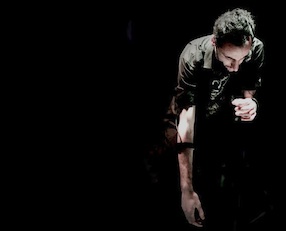
Performer, new media, sound artist and teacher, Marco Donnarumma was born in Italy and is based in London. He is a PhD student at Goldsmiths, University of London, funded by the European Research Council and supervised by Prof. Atau Tanaka and Dr. Matthew Fuller. Marco looks at the collision of critical creativity with humanized technologies. He is known for his body-based performance works with custom open biotechnologies and physical interactive systems. He is a Harvestworks Creativity + Technology = Enterprise Fellow (New York, US) with support by the Rockefeller Foundation. Marco has performed and spoken in 50 countries including US and South America, Europe, India, China, South Korea and Australia. His works have been selected at leading art events (ISEA, Venice Biennale, WRO Biennale), specialized festivals and venues (FILE, Panorama, EMPAC, New York Electronic Arts Festival, Sonorities, Némo, Mapping, Piksel, Re-New, Laboral) and major academic conferences (NIME, ICMC, Pure Data Convention, Linux Audio Conference @ Stanford CCRMA, SICMF). He curated a comprehensive journal publication on biotech and performing arts entitled Biotechnological Performance Practice (eContact! 14.2). His writings have appeared in the Leonardo Electronic Almanac (MIT Press), in the book “New Art/Science Affinities” (CMU and Studio for Creative Enquiry, US), and several times in specialised conference proceedings. His biophysical system Xth Sense won the 1st prize in the Margaret Guthman Musical Instrument Competition (Georgia Tech, US). His latest installation with Marije Baalman entitled “Nigredo” was recently awarded the 2nd prize in the TransitioMX New Media Art Award (MX). He has been artist in residence at STEIM (NL), Inspace (UK), and National School of Theatre and Contemporary Dance (DK). His work has been funded by the European Commission, British Council, Creative Scotland, New Media Scotland, and the Danish Arts Council. His projects have been reviewed on BBC, Reuters, Wired, RTVE, El Pais, Weave, Create Digital Music, We Make Money Not Art, Rhizome, and Digicult. Marco teaches regularly worldwide for academic institutions and media labs. Past courses were hosted at Harvestworks in New York, US; SESC Sao Paulo in Brazil; UNAM and CENART in Mexico; UPR Universidad de Puerto Rico; STEIM in Netherlands; NK and LEAP in Berlin; Newcastle CultureLab, University of London, Glasgow Centre for Contemporary Arts in the UK; Gotland University Institute for New Media Art and Technology in Sweden; Academy of Fine Arts of Brera and Pierluigi da Palestrina Conservatory in Italy. Currently, he investigates how body theory can provide perspectives on the design of combined biosensing and machine learning technologies for music and the performing arts.
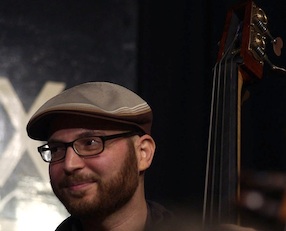
Adam Linson is active internationally as a double bassist, improviser, composer, and scholar, who performs acoustically and with live electronics, solo and in a wide variety of ensembles. He also designs, develops, and performs with real-time interactive computer music systems. He is currently completing his doctoral research in Artificial Intelligence and Improvised Music at the Open University (UK), in the Faculty of Mathematics, Computing and Technology. His research interests extend to other areas of musical human-computer interaction, especially phenomenology and cybernetics. He received an MFA from Bard College in 2012, and a BA in Philosophy from the University of California, San Diego in 1998, where he also studied composed and improvised music under George Lewis (now his PhD co-advisor), and classical double bass under Bertram Turetzky. As a software engineer and GNU/Linux specialist, he has extensive experience in the private sector, ranging from large-scale distributed architectures to embedded systems. From 1999-2009, he was based in Berlin, Germany, where he began many continuing musical collaborations with distinguished improvisers. He performs regularly in concert series and international festivals, and can be heard on several critically-acclaimed albums. His performances and recordings have been broadcast on US and international radio, including BBC Radio 3 in the UK and SWR in Germany. In 2004 and 2008, he was an artist-in-residence at the Studio voor Elektro-Instrumentale Muziek (STEIM), Amsterdam. His compositions for chamber ensembles and contemporary dance productions have been performed in Europe and North America. Linson is originally from Los Angeles, California, and currently divides his time between the UK and Canada.
|
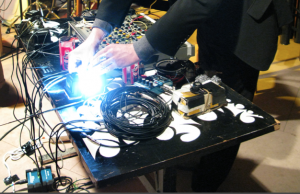 Sound is an experience of inhabitation. It is a sign of organisms and materials in interaction, of the formation, flow and dissolution of systems. This experience is historically, culturally, socially, materially situated: our sonic experience is embroiled with the systems in which we dwell.

Keynote – Simon Waters
Inhabiting Sound Seamus Heaney – ‘Clearances’ In Memoriam M.K.H., 1911-1984 She taught me what her uncle once taught her: How easily the biggest coal block split If you got the grain and the hammer angled right. The sound of that
Keynote – Simon Waters
Inhabiting Sound Seamus Heaney – ‘Clearances’ In Memoriam M.K.H., 1911-1984 She taught me what her uncle once taught her: How easily the biggest coal block split If you got the grain and the hammer angled right. The sound of that

Sean Williams – From centimetres to seconds: sound design’s shift from technical serialism to musically informed performance practice in the 1950s WDR Studio, Cologne
Music made in the West Deutsche Rundfunk Studio for Electronic Music in the 1950s was characterized by a strict serialist determination of all sound parameters. In Karlheinz Stockhausen’s Studie II, and Gesang der Jünglinge, sounds as short as 0.05 seconds
Sean Williams – From centimetres to seconds: sound design’s shift from technical serialism to musically informed performance practice in the 1950s WDR Studio, Cologne
Music made in the West Deutsche Rundfunk Studio for Electronic Music in the 1950s was characterized by a strict serialist determination of all sound parameters. In Karlheinz Stockhausen’s Studie II, and Gesang der Jünglinge, sounds as short as 0.05 seconds

Richard Coyne – Why sound reaches the parts architecture can’t
“Physical spaces are charged with meaning and emotion for most of us — some spaces more than others. But it’s rare to enter a building or encounter spectacular scenery and experience the same intensity of emotion many of us feel
Richard Coyne – Why sound reaches the parts architecture can’t
“Physical spaces are charged with meaning and emotion for most of us — some spaces more than others. But it’s rare to enter a building or encounter spectacular scenery and experience the same intensity of emotion many of us feel

Panel discussion – Scaling to fit and coping with detail
Sound is data. Alterations in the structure of data can create events of audible and emotional value. Delayed and modulated samples create filters, an array of samples create microseconds of a wavetable, milliseconds and seconds of samples create distinguishable sound events.
Panel discussion – Scaling to fit and coping with detail
Sound is data. Alterations in the structure of data can create events of audible and emotional value. Delayed and modulated samples create filters, an array of samples create microseconds of a wavetable, milliseconds and seconds of samples create distinguishable sound events.

Not a Concert – drinks reception and installation launch
Drinks reception in B28, 6pm Attendees are welcome to this reception in room B28, a room filled with loudspeakers and currently used to support NESS (Next generation Sound Synthesis), an ERC funded project concerned with sound synthesis, effects processing and
Not a Concert – drinks reception and installation launch
Drinks reception in B28, 6pm Attendees are welcome to this reception in room B28, a room filled with loudspeakers and currently used to support NESS (Next generation Sound Synthesis), an ERC funded project concerned with sound synthesis, effects processing and

Concert – fractions and factions
Tonight’s concert will feature Jules Rawlinson’s Please use the tramps provided, a wacom-tablet driven piece of live electronics. Lauren Hayes will perform an improvisation called contactor. playRoom Martin Parker’s anti-sweetspot rant has been cancelled. Please come to Inspace for 8pm,
Concert – fractions and factions
Tonight’s concert will feature Jules Rawlinson’s Please use the tramps provided, a wacom-tablet driven piece of live electronics. Lauren Hayes will perform an improvisation called contactor. playRoom Martin Parker’s anti-sweetspot rant has been cancelled. Please come to Inspace for 8pm,

Keynote – Joe Banks – Sound Art as Mainstream Cultural Commodity
Author and sound artist Joe Banks argues in his book “Rorschach Audio – Art & Illusion for Sound” that “the earliest form of sound recording technology was not a machine but was written language”. Extrapolating this argument, Joe Banks discusses
Keynote – Joe Banks – Sound Art as Mainstream Cultural Commodity
Author and sound artist Joe Banks argues in his book “Rorschach Audio – Art & Illusion for Sound” that “the earliest form of sound recording technology was not a machine but was written language”. Extrapolating this argument, Joe Banks discusses

Peter Nelson – Phrase and Gesture: the timing and syntax of sounds
“How do sounds add up? What pulls moments together into meaningful strands? Whether sounds are static, rhythmic or fleeting, they carry us with them in ways that determine senses of speed, character and emotion. This talk concerns not just sounds
Peter Nelson – Phrase and Gesture: the timing and syntax of sounds
“How do sounds add up? What pulls moments together into meaningful strands? Whether sounds are static, rhythmic or fleeting, they carry us with them in ways that determine senses of speed, character and emotion. This talk concerns not just sounds

Craig Martin – Listening with Michel Serres: Sounding Objects
In his recent book Biogea the philosopher Michel Serres makes the case for the need to listen to the world. Rather than following the lengthy traditions of human-centred domination of the material and natural world Serres calls for the need
Craig Martin – Listening with Michel Serres: Sounding Objects
In his recent book Biogea the philosopher Michel Serres makes the case for the need to listen to the world. Rather than following the lengthy traditions of human-centred domination of the material and natural world Serres calls for the need

Panel discussion – sound design and violence
Sounds are made when surfaces meet and resist. If the resulting vibrations are constrained, funnelled and pressurised down tubes, across vent holes and around resonant cavities we can design either a musical instrument or a sonic weapon. Sound touches at
Panel discussion – sound design and violence
Sounds are made when surfaces meet and resist. If the resulting vibrations are constrained, funnelled and pressurised down tubes, across vent holes and around resonant cavities we can design either a musical instrument or a sonic weapon. Sound touches at